// IDHD
We didn’t lose our attention spans. We lost the moment where we decided what to pay attention to.
A post about the attention economy, the intention economy we could have had, and what the distance between them has quietly done to creativity, trust, and the future we’re building.
Also: a reconditioned iPod, rocket boots for terrible ideas, and an ocean of artificial intelligence.
Attention
Attention Deficit Disorder describes a person’s struggle to sustain focus. I have it. Executive dysfunction, one of the key symptoms, often gets mistaken for laziness. It’s not a lack of intent.
The Attention Economy describes an entire system built to capture that focus.
I’ve been thinking about what comes after.
Hyper Reality by Keiichi Matsuda 2016
The obvious story is attention capture. You know it. Your phone is designed to make it hard to stop looking at your phone. Notifications, infinite scroll, autoplay. These aren’t side effects. They’re the product.
But attention capture is the easy story. What comes after is the interesting bit.
The gap
There used to be a moment between wanting something and having it. Long enough to ask a question. Do I actually want this? Is this the right time? Why am I doing this?
That moment is friction. And we spent fifteen years engineering it out of everything.
One-click purchase. Swipe to match. Autoplay. Data-driven recommendations instead of searches you had to type. Every one of these decisions was made in the name of convenience. It’s been great for business of course (and my career) but what we removed, quietly and completely, was the point in the process where you had to know what you wanted.
Frictionless systems get compliance. Not choice.
I wrote about this in the post-optimal piece. The friction we’ve been buffing out was often load-bearing. Remove it and the whole thing gets lighter in the wrong way.
The short-term cost is fragmented attention. Everyone’s talking about that.
The longer-term cost is something quieter.
Intent atrophy
If you outsource enough decisions, the muscle that makes decisions atrophies.
Part of why this crept up on us: forming intent is effortless. Marvin Minsky wrote that we’re least aware of what our minds do best. We’ve been inferring goals and setting intentions for millions of years. It barely feels like anything. Which is exactly why we didn’t notice when we started outsourcing it.
The system has been supplying purposes for so long. Here’s what to watch next. Here’s a template. Here’s a prompt. Here’s what people like you tend to want. Coming up with your own purpose starts to feel like unnecessary effort. You start mistaking what people want you to want for what you actually want.
That’s the second-order condition. I’m half-jokingly calling it Intention Deficit Homogenisation Disorder. The problem isn’t focus. It’s having nothing in particular to focus on.
The intention economy
There’s a version of this that works differently. The intention economy. Doc Searls got there first, in 2006.
In the attention economy, everyone is shouting. Every market trader on the street trying to be louder than the last, finding new ways to get in front of you before you’ve decided what you’re looking for. The escalation is baked in. Everyone has to shout louder because everyone else is shouting louder.
The marketing term is eyeballs. Put something in enough people’s eyeballs and some of them are sure to comply.
In an intention economy, you’d state what you were looking for first. Only the traders who could actually help you would compete for your attention. The rest could direct their energy where it was more relevant. Less noise. More signal. Better for everyone, except possibly the people making money from the noise.
Google built this, more or less. Search ads only appear when you’ve already said what you want. The intent is there before the ad. It’s why they convert better than almost anything else in advertising. Then Google bolted an entire attention economy on top of it anyway. Display ads. Remarketing. The trainers that follow you around the internet for weeks. The LED TVs even though you just bought an LED TV. The intention economy works better for users. The attention economy works better for quarterly targets.
The inversion
Searls wrote that piece in 2006. He was right about the idea. He was optimistic about who’d run with it.
The same people making money from the noise noticed something. The most valuable data is stitched together from many sources. Your plans, your searches, your browsing history, your actions, your hesitations, your location, your previous locations. Your chat history or the casual message you sent a chatbot about changing jobs, or moving house, or what to make for dinner.
Every time you state a goal to a language model, you’re handing over signal about your intentions. Researchers are already warning about what this means for consumer behaviour and for democracy.
Searls imagined buyers declaring intent to the market. What’s emerging instead is the market extracting intent from you, via surveillance, before you’ve decided to act on it.
By December 2024, Cambridge researchers were using the same phrase as Searls for the opposite thing. He asked them to find a different name:
Our intention economy is an optimistic and potentially world-changing aspiration while theirs is a pessimistic world-worsening possibility.
Our intention economy has eighteen years of work behind it while theirs has this single study.
The attention economy wanted your eyes.
This wants to know every detail about you so it can predict your intent.
The iPod
A year or so ago I bought a reconditioned iPod. Not as a nostalgia exercise. As an act of self-defence.
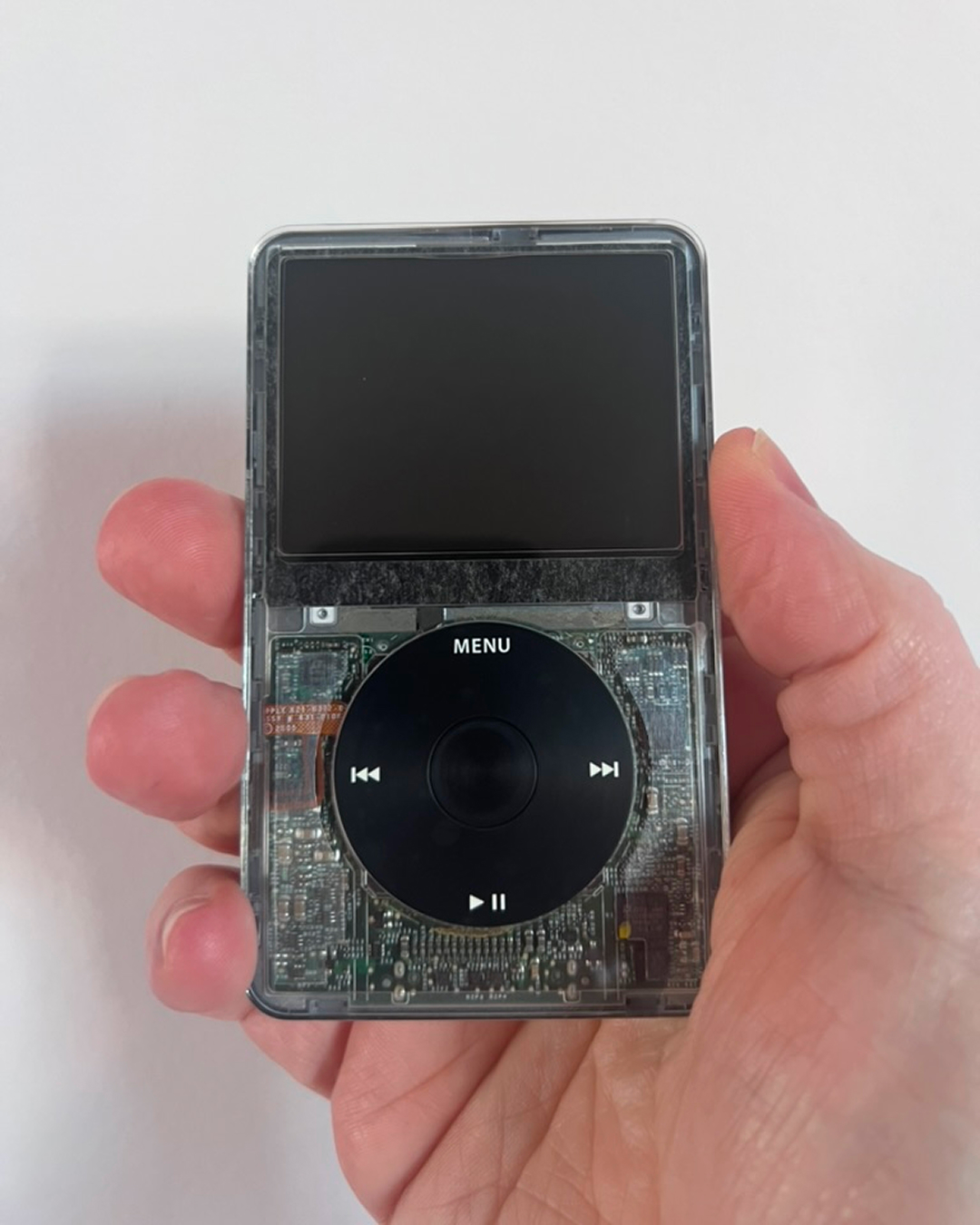
I go for walks without my phone now. Commuting is calmer. The pull of the notification, the reflex to check, the low-grade anxiety of being reachable. Gone. Just me and whatever I loaded before I left the house.
What I wasn’t expecting was what the limitations would teach me.
The UI is clunky because it wasn’t designed for “engagement”. The search is ok, but very straightforward. If I want to find something I have to know what I’m looking for, and I have to remember the name of it. I can’t just let an algorithm surface something. I have to choose music with intent.
It’s changed how I listen. I’m more deliberate about what I put on it. I think about what I’m in the mood for before I leave the house. I sit with albums properly, because skipping around is more effort than it’s worth.
The shortcomings are the feature. The friction is doing exactly what friction is supposed to do. It’s forcing the moment where I have to know what I want.
It’s also changed how I relate to the music itself. It feels like the main act again. Which is what it always was, before we decided that was too much to ask of people.
What it does to creative work
Creativity has always needed friction.
The blank page. The decision about what to make and why it matters. The tolerance for the period when it isn’t working yet. I experience this every time I sit down to make music. The early part of a session, before anything has taken shape, is uncomfortable. You have to push through it to get anywhere. That discomfort is where the work becomes yours.
Low-friction creative tools let you skip it. Autocomplete, generative defaults, template culture. You can produce output without forming intent. The work exists. It just wasn’t aimed at anything.
I’ve heard this from hiring managers recently. A growing portion of early-career designers have never worked without a component library or design system. They can produce the output. They struggle to explain why they made the decisions they made. The reasoning was already baked into the tool. The intent came pre-rolled.
The designers who tend to thrive are the ones who came up mocking things from scratch, then adopted design systems, then AI. They understand why things work because they had to make them work manually first. Now they can move fast because they know where they’re going.
I use tools. I use AI. I find them useful. The ones worth worrying about are the ones that remove the decision along with the effort. They skip the part where you had to know what you were making, and for whom, and why it mattered.
If you don’t come to AI with a strong sense of what you want and why, you’re the one who’s artificially intelligent. AI is rocket boots for terrible ideas. Bring your intelligence, your curiosity, your taste and your conviction to it, and it becomes a genuinely powerful tool for your thinking.
Nielsen Norman Group made a related point in their State of UX 2026 report. UX Roles will increasingly demand breadth and judgment, not just artifacts. The practitioners who thrive are the ones who treat design as strategic problem solving rather than producing deliverables. That’s been my approach for as long as I can remember. Not because it’s suddenly the smart career move. Because deliverables without strategy are just output.
The result is a lot of work that’s technically created but not authored. Competent. Fast. Forgettable. And because the tools trend toward the average of everything that already exists, it converges. Without intent, creative work regresses toward the mean. Volume replacing vision.
An ocean of the adequately similar.
An ocean of artificial intelligence.
That’s the homogenisation part.
Trust
Optimise everything toward the same metrics and you get the same product. An optimisation mindset will only get you to the local maxima of a bad idea. It’ll never make a leap of conviction that differentiates.
Every streaming service with the same recommendation engine. Every app with the same onboarding flow, the same design system, the same brand colours. Every city centre with the same six shops, because retail property managers optimise for the same credit ratings and footfall numbers. Every festival and club with the same data driven lineup.
Kyle Chayka coined a name for this in 2016. AirSpace. The strangely frictionless geography created by digital platforms. The same coffee shop in Berlin, Bucharest and Cape Town. Not a chain. Independent businesses, unknown to each other, converging on the same aesthetic through algorithmic pressure. Subway tiles. Hanging plants. Flat whites. He wrote the book on it in 2024. Filterworld.
They weren’t authentic to their place, he observed. They were authentic to the internet.
Cory Doctorow calls this enshittification when it happens to a platform. This is what it looks like when it happens to an entire market.
In that world, switching is easy. Every competitor is more or less functionally identical, so the moment trust breaks, the customer’s intent becomes simple and clear. I don’t want to use this company again. If the competitor doesn’t even need to do a better job, they’re never coming back. There’s no hook for customer intent.
That intent is as declared and purposeful as anything the intention economy runs on. It’s just pointed the wrong way.
The irony is that hyper-optimisation was supposed to maximise retention. Frictionless onboarding. Personalisation. Engagement loops. But in converging toward the same product as everyone else, it removed the one thing that would have made leaving difficult. Character. Differentiation. The bit you couldn’t get anywhere else.
Trust is the only differentiator that matters. Sarah Gold and her team at Projects By IF have been saying this for a decade now.
The traffic jam
There’s a line from Monika Bielskyte I keep coming back to. You can invent the car by imagining a world without horses. To be genuinely futuristic, you have to imagine the traffic jam.
The people who built the attention economy weren’t all cynics. They imagined connection. Access. Community at scale. They didn’t imagine what a billion of those systems would do to how people think and talk to each other. Or they chose not to.
The same question hangs over the intention economy. Both versions of it.
Holly Herndon and Mat Dryhurst spent this year making art about exactly this. Their installation at the Venice Biennale had one plaque. It read: “When machines are capable of building anything, the most difficult question is understanding what we want and why.”
Dryhurst calls what comes after the slop period an intention economy. Same phrase. Different decade.
Bielskyte makes another point that’s worth sitting with. Building something genuinely useful in healthcare, in education, in creative work requires accuracy, reliability and sustained effort. To spread disinformation or deepen social division, it only has to be cheap, fast and convincing enough. The destructive path is structurally easier. That’s why the traffic jam keeps happening, and why it’s most dangerous early on, before anyone fully understands what’s been built.
The builders of these systems have their own intent deficit. Growth targets. Engagement metrics. Conversion rates. Those are proxies for intent. The harder question is what kind of world we actually want to make. It rarely makes the slide deck. It’s not an OKR.
Some researchers are already building this differently. MIT’s CSAIL published work on an algorithm that infers what you meant to do, not just what you did. They modelled it on something a toddler can already do: watch someone struggling to open a cabinet full of books, figure out what they were trying to do, and open the door for them. The toddler doesn’t observe the action. They infer the goal.
The lead researcher put it plainly: “Ideally, the algorithms of the future will recognize our mistakes, bad habits, and irrationalities and help us avoid, rather than reinforce, them.”
That’s what the other version of this looks like.
Technology has no inevitable trajectory. We can direct this toward strengthening human agency rather than exploiting human vulnerability. That’s an act of intent.
The intent has to live somewhere in the process. Make sure it does.
The attention span story is true. It’s just not the whole story.
We didn’t lose our attention.
We lost the moment where we decided what to pay attention to.
I'd love to tell you more.
// DAW Sketch Namer
My music WIP folder is a graveyard of jams and sketches with names like “asdfgh” and “New 33”. I never know what any of them are. I made this to help sort that out.